Tagbaya Public Response
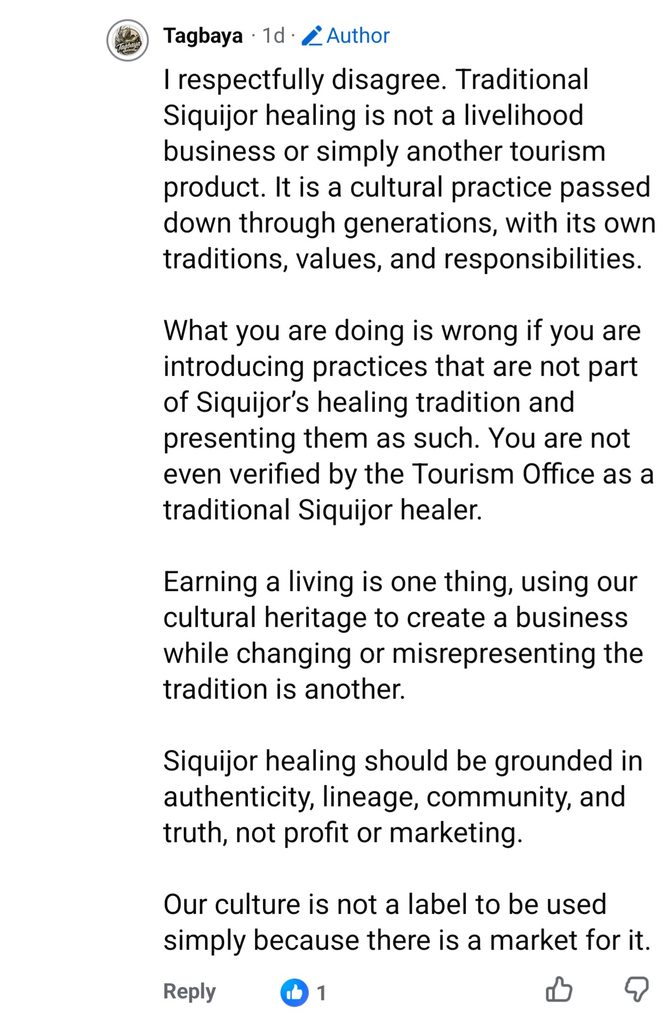
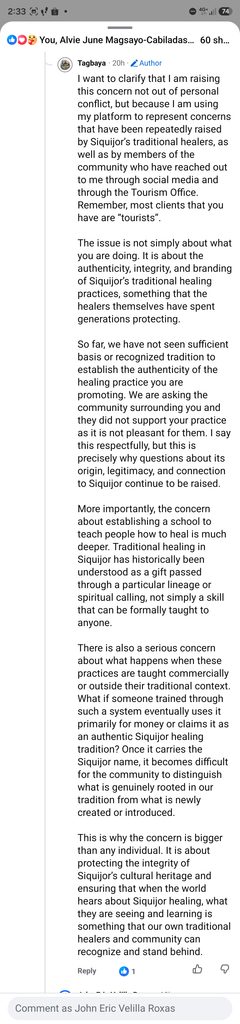
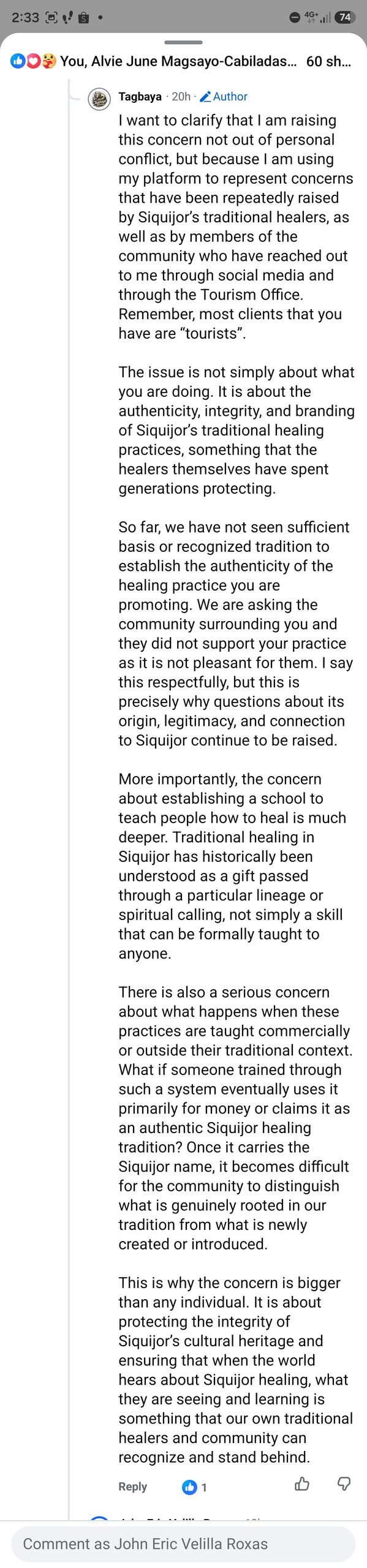
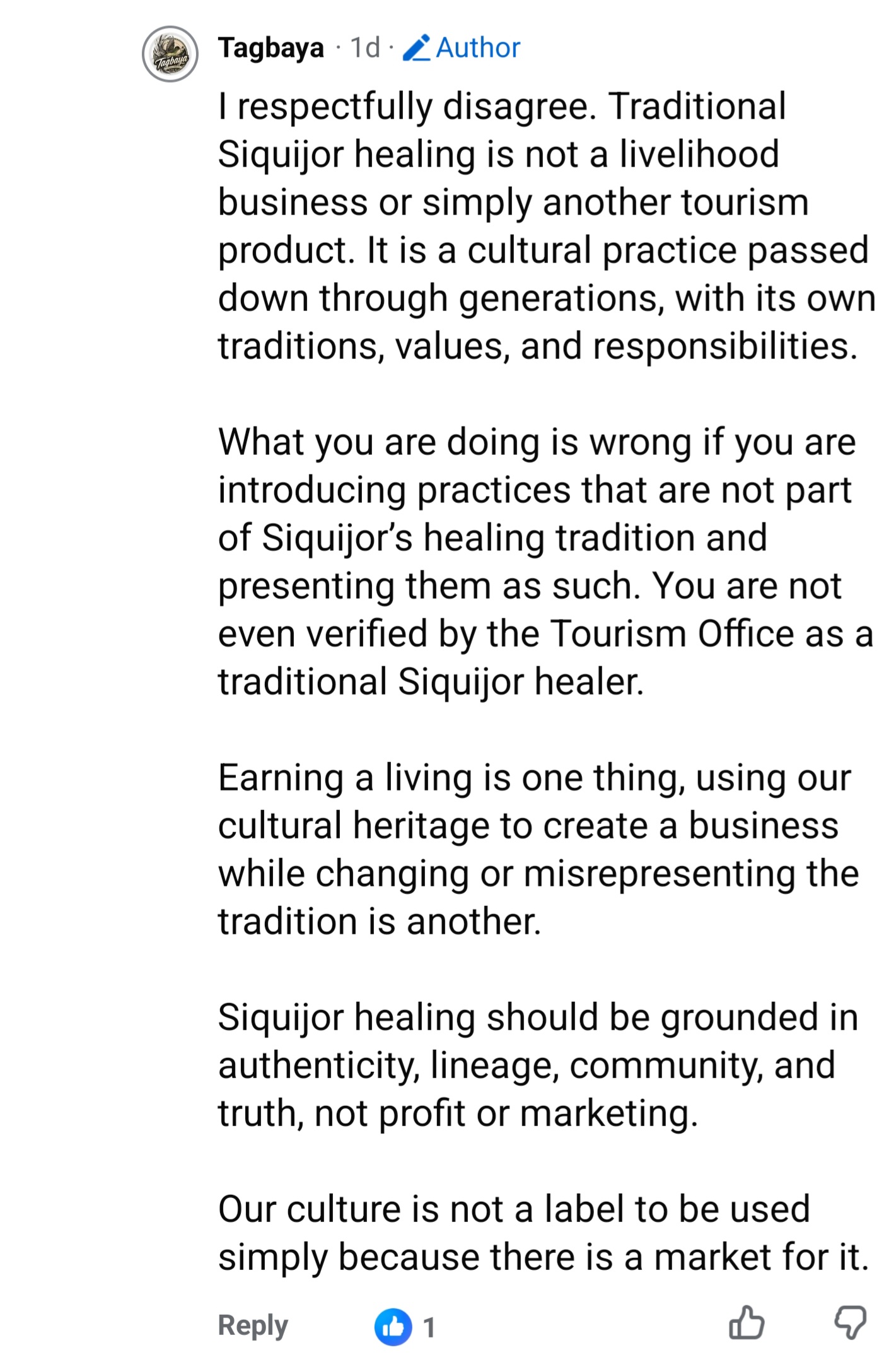
The claims above are made by Tagbaya page managed by Luis Borongan. I will address these statements here.
I want to address this publicly because specific claims have now been made publicly about me and the work that I do.
Luis Nathaniel Lumingkit Borongan, Tagbaya —the page you own and manage—responded to my comment by suggesting that I am introducing practices that are not part of Siquijor’s healing tradition and presenting them as such. The response also pointed to the fact that I am not verified by the Tourism Office as a traditional Siquijor healer.
I respect your advocacy for protecting Siquijor’s cultural heritage. In fact, I agree with much of your original message: traditions should not be falsely represented, practices from elsewhere should not simply be labeled as traditional Siquijor healing, and our traditional knowledge deserves protection and proper documentation.
But because my own practice and integrity have now been questioned publicly, I also need to clarify where I come from.
I did not create a business and then attach “Siquijor healing” to it because I saw a market.
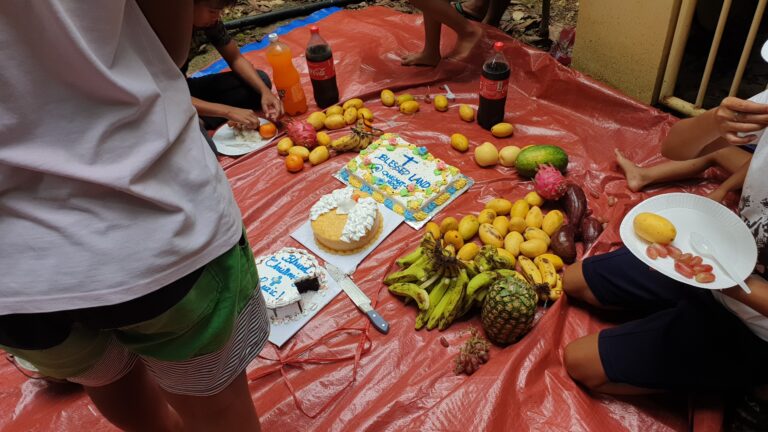
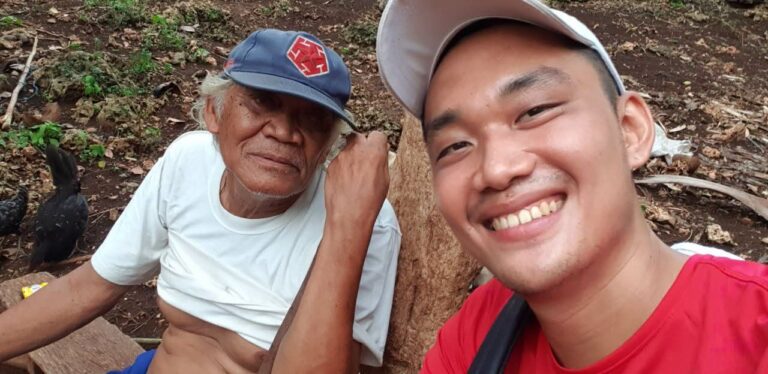
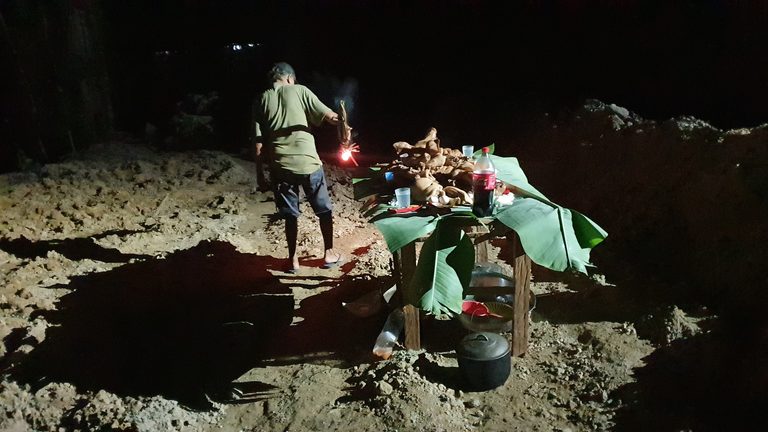
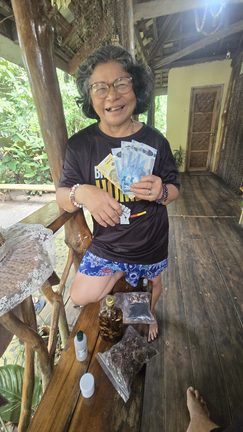
My practice is rooted in a Siquijor healing lineage. My knowledge has been transmitted through traditional practitioners and direct personal mentorship.
This existed before our website, before our school, before our public activities, and before we began opening our work to a wider audience.
What is new is not the lineage. What is new is that our lineage is now becoming more open to the public.
We were already practicing and serving people before seeking any recognition from tourism.
I respect the Tourism Office and I am open to any appropriate process for recognition or accreditation. But I respectfully disagree with using the absence of Tourism Office verification as evidence that a healing lineage is illegitimate.
Tourism recognition and traditional lineage are not the same thing.
Tourism recognition can serve an important administrative and public-facing purpose, but it does not create or determine the existence of a healing lineage that has been transmitted through practitioners and teachers.
Authenticity should be examined through the teachers, lineage, transmission, history, practices, and community roots involved.
We also operate as a registered business. That does not prove the authenticity of our lineage either.
Business registration, tourism recognition, and traditional lineage establish different things.
There is one allegation, however, that I take very seriously.
You suggested that I am introducing practices that are not part of Siquijor healing and presenting them as though they are.
If you believe I have misrepresented a specific practice as traditional Siquijor healing, please identify it so we can discuss it based on facts.
If I have genuinely attributed something incorrectly, I am willing to examine it and correct it.
I also want to make my own position clear:
I do not claim that everything I personally study, know, or practice is part of traditional Siquijor healing.
There is knowledge transmitted through our Siquijor tradition. There can also be modern adaptations and knowledge learned from elsewhere.
Those distinctions should be made honestly.
Traditions can evolve, but new adaptations should be identified as adaptations rather than retroactively presented as traditional practices.
And this brings me back to the point of my original comment:
A traditional healer should not be expected to remain poor in order to be considered authentic.
Healers have families, expenses, and everyday needs. Their time and knowledge have value. Preserving and transmitting knowledge also requires time and resources.
Of course, business can exploit culture. False histories, deception, cultural misrepresentation, and using Siquijor merely as a marketing label deserve criticism.
But earning money is not, by itself, exploitation.
When practiced responsibly, livelihood can help practitioners continue their work, compensate teachers and elders, support documentation and education, and give the next generation a realistic opportunity to carry the tradition forward.
That is why I reject the idea that we must choose between authenticity and livelihood.
We can protect Siquijor healing from misrepresentation and allow legitimate practitioners to earn a dignified living.
We can preserve what our elders taught us and honestly identify what is new.
And we can respect tradition without romanticizing the poverty of the people carrying it.
Luis, I am not asking you or Tagbaya to automatically endorse me or agree with everything I do. Scrutiny is welcome.
But if my integrity or lineage is going to be questioned publicly, I believe it is reasonable to ask that we discuss specific practices and claims rather than assumptions.
If our shared goal is genuinely to preserve Siquijor’s healing heritage, then I believe the conversation should be about lineage, documentation, truthful attribution, ethical practice, and how we make transmission possible for the next generation.
On those things, perhaps we have more common ground than this disagreement suggests.